
 William Roy

Have you ever been digging through an old box at an estate sale or at an old-fashioned workshop kit and realized something was not right? You may have come upon a set of little closed tubes of glass holding little, rolling balls of metal. On the surface they resemble tiny-scale scientific experiments or even ornaments of some past age. But these objects are not intended to be on display only, they had a crucial, high-precision purpose in the world of craftsmanship.
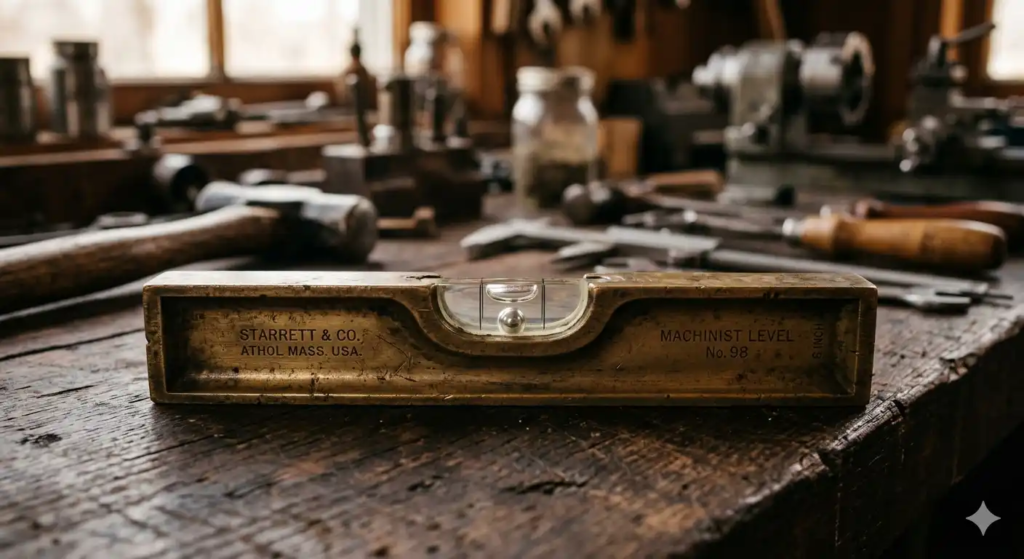
The Hidden Mechanics of the ‘Bullseye’
These curious items are in fact, special leveling devices, which were once called bullseye levels or machinist levels. Although the majority of us are accustomed to the long and rectangular levels which are applied in home construction and which are based on a single air bubble located in the liquid, these circular glass vials were created to face another problem. They were designed to balance in more than one direction at the same time.
The fact that the level was compact and was made in a radial form meant that a craftsman could put the level on a surface and immediately determine whether it was leaning in any direction, not necessarily left or right. This 360 degrees feedback rendered them indispensable in the establishment of heavy machinery, the levelness of billiard tables, or the balancing of the fragile laboratory equipment in every possible angle.
Balls vs. Bubbles: An Alternative Physics.
In most European old-style designs and heavy industrial versions, the classical bubble had been replaced with small steel ball bearings. The reasoning was simply brilliant, which was gravity. Such balls roll automatically to the lowest point possible within the tube of curved glass. This offered a high contrast visual indicator that was frequently much more legible than a floating bubble particularly in poorly lit factories or in conditions where heavy vibrations could cause a liquid bubble to bounce around and disintegrate.
They even used several balls in some of the high-end models. This was not only to look good, but several indicators made possible a greater level of mathematical accuracy, which enabled the user to locate the center of the true object, with amazing precision. It is a tribute to the era when engineering was based on the ingenious use of physical laws and disregarded the digital sensors and displays.
Where to Find Them and How to Deal with Them.
These glass tubes nowadays are most apt to be found in settings of polished brass, rich mahogany, or coarse cast iron. They are trendy discoveries in old-time stores, old-fashioned tool collections, and old-time estates. Although they are pretty to the eye, they do need some respect as far as safety is concerned.
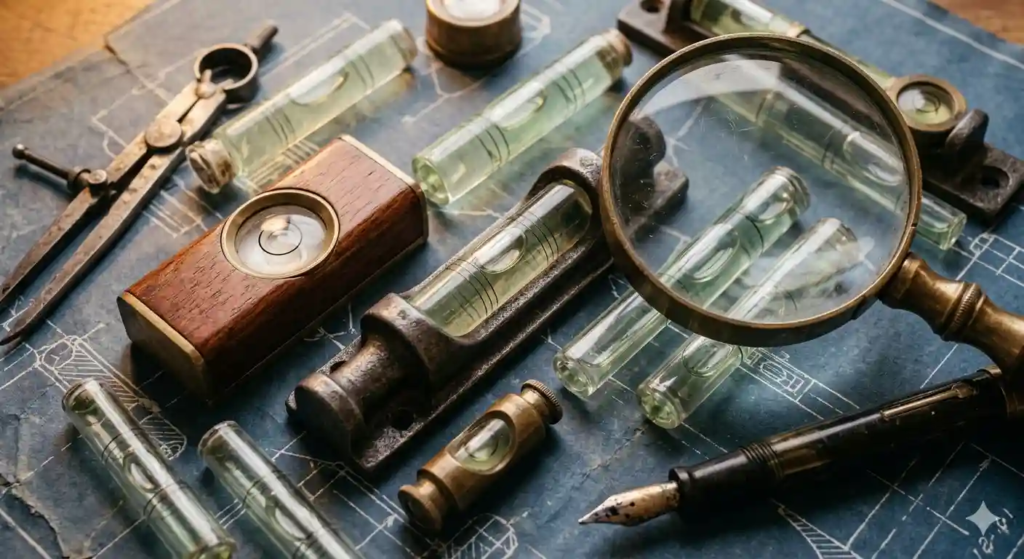
A Legacy of Craftsmanship
These small glass tubes now have a new value as an object of industrial art, in addition to their usefulness. They are not only appreciated by collectors because of what they are, but the history of accuracy. A large number of fans have also been adding these old vials to artistic steampunk projects or shadowboxes to emphasize their unusual geometry.
When you are holding one of them in your hand, it is like touching history. It is a time when perfection was attained by using plain materials, careful design, and an eye of an artisan. In the digitalized world of computerized levels and laser directions, there is a whole lot of satisfaction in the pure sound of a metal ball rolling in a glass tube.



GIPHY App Key not set. Please check settings